TL;DR:
- Sexually transmitted diarrhoea isn’t one disease. It’s a lay term for gut infections, most often Shigella, that spread through tiny traces of faeces (poo) during sex.
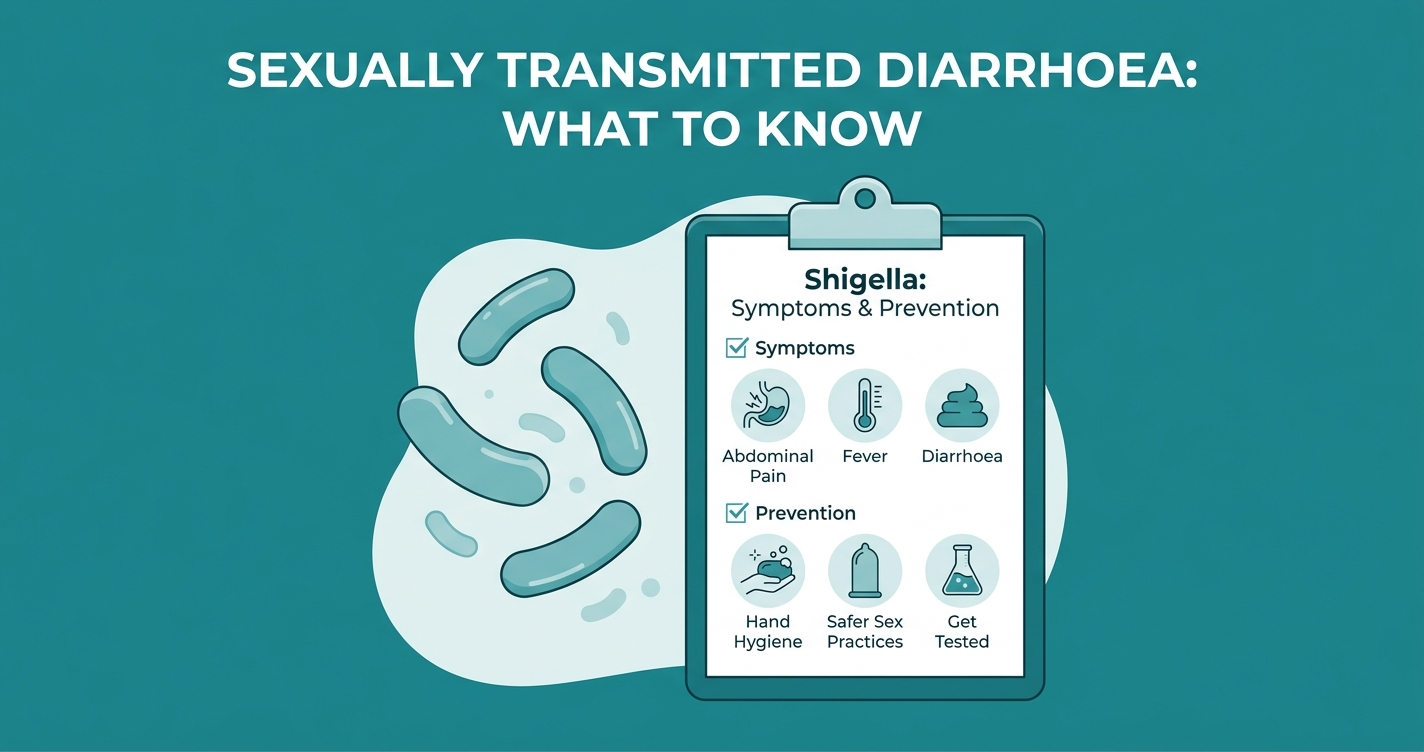
- Symptoms usually begin 1 to 3 days after exposure. They include diarrhoea (sometimes bloody), stomach cramps and fever.
- Bloody diarrhoea needs an urgent GP appointment or a call to NHS 111. Don’t wait it out.
- Advice on when it’s safe to have sex again ranges from 48 hours to 2 weeks. The table below explains why.
Sexually transmitted diarrhoea is back in the headlines. A study led by the University of Cambridge, published in July 2026, found that sexually spread Shigella is growing faster in the UK than Shigella caught through travel or food. It is also becoming harder to treat.
Most people have never been told that diarrhoea can pass between partners. That gap can leave people confused, embarrassed and unsure what to do. This guide explains what it is, how to spot it, when to get tested and how to lower your risk.
What Is Sexually Transmitted Diarrhoea?
Sexually transmitted diarrhoea means a gut infection passed between sexual partners through tiny amounts of faeces. Doctors call these sexually transmitted enteric infections. “Enteric” simply means “of the gut.” The British Association for Sexual Health and HIV (BASHH) published the first UK national guideline on managing them in 2023.
It’s usually Shigella, but not only Shigella
Shigella is the best-known cause. It’s a group of bacteria that cause an intestinal infection called shigellosis, also known as bacillary dysentery. The UK Health Security Agency (UKHSA) says two species, S. sonnei and S. flexneri, are the most common in the UK.
Other germs can spread this way too. Australian national STI guidelines describe two patterns:
- Enteritis: watery diarrhoea and cramping in the middle of the belly. Possible causes include Giardia, Cryptosporidium and E. coli.
- Proctocolitis: inflammation of the rectum and colon, with bloody diarrhoea, mucus and lower belly pain. Possible causes include Shigella, Campylobacter and Entamoeba histolytica.
Because several germs can cause similar symptoms, only a lab test can tell them apart.
How Is Diarrhoea Sexually Transmitted?
It spreads by the faecal–oral route: a tiny amount of infected poo gets into someone’s mouth. You can’t see it or smell it. UKHSA’s older public leaflet notes it can happen even when nothing looks dirty.
Which sexual contact carries risk?
The UKHSA lists these routes:
- Oral–anal contact (“rimming”)
- Oral sex after anal sex
The CDC adds that Shigella can sit on the skin around the anus, buttocks and thighs. It can spread to anyone who touches that skin and then touches their mouth. UKHSA’s leaflet also warns about condoms, sex toys and douching equipment that have touched faeces.
Why such a small amount is enough
Shigella is unusually easy to catch. The Cambridge team says about 10 bacteria can cause illness, while Salmonella needs over a thousand. A 2025 study gives a range of 10 to 100.
Some people carry the bacteria without feeling ill. UKHSA says this can still pass the infection on.
Symptoms: How to Tell It From Food Poisoning
The main symptoms are diarrhoea (sometimes bloody), stomach cramps, fever, nausea and vomiting. UKHSA says they usually start 1 to 3 days after exposure, though it can take up to a week. Some people also get headaches and lose their appetite.
Most people recover within 4 to 5 days. Illness can last up to 2 weeks.
Symptoms involving the back passage can include mucus, pain and lower belly cramps, as described in the Australian guidelines.
Many people assume it’s food poisoning. The UKHSA notes that symptoms are commonly mistaken for it. Your recent sexual history is one useful clue, but it doesn’t prove the cause. Diarrhoea after sex isn’t always an STI.
Get urgent help if you have bloody diarrhoea. UKHSA advises asking for an urgent GP appointment or contacting NHS 111. Severe dehydration is also a risk, according to the Cambridge researchers.
Who Is Most at Risk?
Anyone can get Shigella, but sexually transmitted cases in the UK are concentrated among gay, bisexual and other men who have sex with men (GBMSM). The CDC notes that young children and travellers are also at higher risk from other routes.
What the numbers show:
- UKHSA reports 2,560 likely sexually acquired diagnoses in England in 2025. That’s up from 2,052 in 2023 and 2,318 in 2024. These figures use adult men with no recent travel as a stand-in, because sexual orientation isn’t recorded in lab data.
- Researchers estimate that more than half of UK Shigella infections are sexually transmitted. The study found no significant rise among non-GBMSM groups.
- Infection isn’t limited to GBMSM. A Canadian public health report notes these infections can occur in heterosexual people who have unprotected anal contact.
Previous research cited by Cambridge suggests up to a third of people with sexually transmitted Shigella are hospitalised. Up to two-thirds also have another STI, including HIV.
Experts stress caution about causes. The Terrence Higgins Trust’s Marc Tweed notes that links to factors like multiple partners are associations, not proof that any one behaviour is the cause.
Awareness is also low among clinicians. One US study found many patient-facing clinicians don’t realise diarrhoea germs can be sexually transmitted. That’s why speaking up matters.
When to See a Doctor and What Testing Involves
See your GP or a sexual health clinic if you have diarrhoea and sex may be the cause. UKHSA advises the clinic route if sexual transmission is possible. Use NHS 111 or an urgent GP appointment if the diarrhoea is bloody.
What to say and ask:
- Tell them about your sexual history. Professor Kate Baker, the Cambridge study’s senior author, urges people to mention it when seeking care.
- Name Shigella. Public health advice has long suggested mentioning it and asking for a stool sample test.
- Ask for a full sexual health screen. UKHSA recommends one, including HIV, for people diagnosed.
- Ask how to tell recent partners. Partner notification is part of the BASHH guideline.
[INTERNAL LINK: STI testing guide → proposed page on what STI tests involve and where to get them]
Treatment and Antibiotic Resistance
Many healthy people recover without medicine, but antibiotics are recommended for severe cases. UKHSA says mild cases are often self-limiting (they clear on their own) and staying hydrated is important. Antibiotics are advised for severe illness, bloody diarrhoea or complications.
A UKHSA press release adds that antibiotics are also recommended for people:
- admitted to hospital
- with diarrhoea lasting beyond 7 days
- with a weakened immune system
Don’t treat yourself. The California health department warns that anti-diarrhoea medicine such as Imodium can make symptoms worse. [VERIFY: confirm this matches current UK guidance before publishing.]
What drug resistance means for you
Antibiotic resistance means bacteria have changed so a drug no longer kills them. The Cambridge study found that by the end of the study period, upwards of 70% of sexually transmissible Shigella strains were resistant to at least one relevant antibiotic. The comparable figure for strains not spread sexually was about 40%.
An extra analysis found fast-growing strains resistant to three major antibiotics: ceftriaxone, azithromycin and ciprofloxacin. The researchers say this is partly linked to antibiotics used to treat other STIs.
This does not mean every case is untreatable. It does mean a lab test and a clinician’s advice matter, because the right drug may differ from case to case.
When Is It Safe to Have Sex Again?
There is no single agreed number. The most cautious reading of the sources is to wait at least 2 weeks after diarrhoea has fully stopped, and to ask your clinician. The advice differs because the sources measure different things.
| Source | What it says | What it’s really measuring |
|---|---|---|
| UKHSA (2026) | At least 48 hours symptom-free before sexual contact. You can stay infectious for up to a month. | Minimum to stop being actively unwell |
| BJGP / UKHSA guidance | Avoid oral–anal contact until 1 week after diarrhoea resolves. | A clinical middle ground |
| CDC | Wait at least 2 weeks after diarrhoea ends. Germs can stay in stool for up to 2 weeks. | How long bacteria may still be shed |
| Prof. Kate Baker, Cambridge | No sex until two weeks after full recovery. | Researcher advice, aimed at stopping spread |
How to use this:
- Feeling better isn’t the same as being non-infectious.
- 48 hours symptom-free is about being well enough, not about being safe for partners.
- The longer windows reflect how long bacteria can still be shed.
- If you’ve been diagnosed, follow your clinic’s advice. It may differ if you have other health conditions.
Want this on your phone or fridge? Our free 48-hour checklist puts the symptoms, red flags and safe-return timeline in one page. [Get the free checklist (PDF)]([LEAD MAGNET URL])
How to Lower Your Risk During Sex
Hygiene and barriers lower the risk, but none of them removes it. Cambridge’s researchers say regular food and hand hygiene advice isn’t enough to interrupt sexual spread, so sex-specific steps matter.
- Wash your hands after sex, and shower if you can.
- Change condoms between anal and oral sex.
- Use gloves for fingering or fisting.
- Don’t share sex toys or douching equipment.
UKHSA’s leaflet also suggests using a barrier, such as a square of latex, for rimming.
Two more habits help:
- Don’t have sex while you have diarrhoea, and wait out the safe-return window above.
- Get a full sexual health check if you think you caught it through sex. The CDPH points out that more than one infection can spread this way.
If you’re curious about how your digestive system works, our gut health guide covers the basics. It doesn’t claim probiotics prevent or treat infections like these.
For more on sexual health, browse our Men’s Health and Women’s Health sections.
Frequently Asked Questions
Can you get diarrhoea from sex?
Yes. Germs in tiny amounts of faeces can pass between partners through oral–anal contact, oral sex after anal sex, or touching contaminated skin or objects. Australian guidelines note that most infectious causes of diarrhoea can be transmitted sexually. Diarrhoea after sex still has other possible causes.
Is Shigella an STI?
It can be. UKHSA says Shigella can spread sexually, particularly among men who have sex with men. It also spreads through contaminated food, surfaces and poor hand hygiene, so not every case is sexually acquired.
How long after sex do symptoms start?
Usually 1 to 3 days, though it can take up to a week, according to UKHSA. Some people have no symptoms at all but can still pass the infection on. If symptoms start, see your GP or a sexual health clinic.
How long are you contagious?
UKHSA says a person can remain infectious for up to a month, even after feeling better. The CDC says the germs can stay in stool for up to 2 weeks after diarrhoea ends. That’s why hygiene matters throughout recovery.
Does sexually transmitted diarrhoea need antibiotics?
Not always. UKHSA says mild cases often clear on their own, but antibiotics are recommended for severe illness, bloody diarrhoea or complications. A stool test and a clinician can decide, especially given resistance concerns.
Conclusion
Sexually transmitted diarrhoea is real, it’s rising in the UK, and it’s often mistaken for food poisoning. Here’s what to remember:
- It spreads through tiny traces of faeces, usually Shigella, during sex.
- Symptoms start in 1 to 3 days. Bloody diarrhoea needs urgent medical help.
- A stool test and a full sexual health screen are the right next steps.
- Most mild cases clear without antibiotics, but resistance makes professional advice important.
- When to resume sex isn’t one number. The cautious choice is 2 weeks after diarrhoea fully ends, or follow your clinician’s advice.
- Hygiene and barriers lower risk but don’t remove it.
If you’re worried, [find a sexual health clinic near you]([VERIFY: insert current NHS sexual health service finder URL]). You can also get our evidence-checked health explainers by email: [subscribe here]([NEWSLETTER URL]).
Next Step
Keep this guide where you’ll need it. Our free “Gut Bug After Sex: 48-Hour Action and Safe-Return Checklist“ covers symptoms, red flags, what to tell a clinician and a timeline for safely resuming sex.
[Get the free checklist (PDF)]
Disclaimer: This article is general information and isn’t a substitute for professional medical advice, diagnosis or treatment. If you have bloody diarrhoea, severe pain, signs of dehydration, or symptoms that aren’t improving, contact NHS 111 or your GP. For testing, contact a sexual health clinic.
Sources:
- University of Cambridge: Sexually transmitted diarrhoea spreading rapidly among some networks of gay men in the UK, study finds
- Marshall et al., The Lancet Infectious Diseases (2026)
- UKHSA: What is Shigella? How do you catch it and how can it be avoided?
- UKHSA: Increase in drug-resistant Shigella cases among gay and bisexual men
- UKHSA: Warning after rise in extremely drug-resistant Shigella
- PHE/UKHSA: Shigella dysentery on the rise among gay and bisexual men
- PHE: Shigella leaflet (2016)
- BASHH: UK national guideline for the management of sexually transmitted enteric infections 2023
- CDC: Preventing Shigella Infection Among Sexually Active People
- CDC: About Shigella
- California Department of Public Health: Shigellosis in men who have sex with men
- Australian STI Management Guidelines: Sex-associated diarrhoea
- Public Health Agency of Canada: Update on STIs
- BJGP: Spotlight on drug-resistant Shigella
- Microbial Genomics (2025): Sexually transmissible Shigella flexneri serotype 1b in England
- Miller et al., Microbiology Spectrum (2024): Sexually transmitted enteric pathogens among MSM


+ There are no comments
Add yours