TL;DR:
- Chikungunya symptoms and treatment in brief: it is a mosquito-borne virus that causes sudden fever and joint pain, usually 3 to 7 days after a bite (CDC).
- There is no antiviral medicine. Care means rest, fluids and pain relief (CDC clinician guidance).
- Until dengue is ruled out, doctors prefer paracetamol (acetaminophen). Avoid aspirin, ibuprofen and naproxen unless a clinician says otherwise.
- Most people improve within 1 to 2 weeks, but joint pain can last for months or even years (TravelHealthPro).
- Get urgent help for severe tummy pain, repeated vomiting, bleeding or any illness in a newborn.
This article is general information and isn’t a substitute for professional medical advice. If you have a high fever, severe pain, bleeding, confusion or signs of dehydration, contact NHS 111 or your GP (or local emergency services).
[Get the free Chikungunya Recovery and Red-Flag Checklist (PDF)]([LEAD MAGNET URL])
You have a sudden fever and your joints ache. Maybe you’ve just come back from a trip, or local cases have been in the news. The big questions are probably “Is this chikungunya?”, “Is it dengue?” and “What can I safely take?”
Chikungunya is spreading in several parts of the world. The European Centre for Disease Prevention and Control (ECDC) counts 250,051 cases and 87 deaths reported in 2026 outside mainland EU/EEA (data to 30 August), and it reported more cases in August than in July. France and Italy have reported locally acquired cases separately. This guide explains the symptoms and treatment day by day. It also covers how to tell chikungunya from dengue, how long joint pain lasts, and when to get help.
What Is Chikungunya and How Do You Catch It?
Chikungunya is a viral infection spread by infected mosquitoes, mainly Aedes aegypti and Aedes albopictus. It does not pass from person to person through touch, coughing or saliva.
Cleveland Clinic explains that the virus (CHIKV) spreads through mosquito bites. Spread through blood is possible but rare, for example in healthcare workers handling infected blood. You can’t catch it from a family member or carer.
Travel to an outbreak area is the most common way people get it. That is changing. TravelHealthPro lists 146 locally acquired cases in France as of 5 October 2026, so some people now catch it without travelling. For ongoing updates, see its chikungunya summary page.
Chikungunya Symptoms
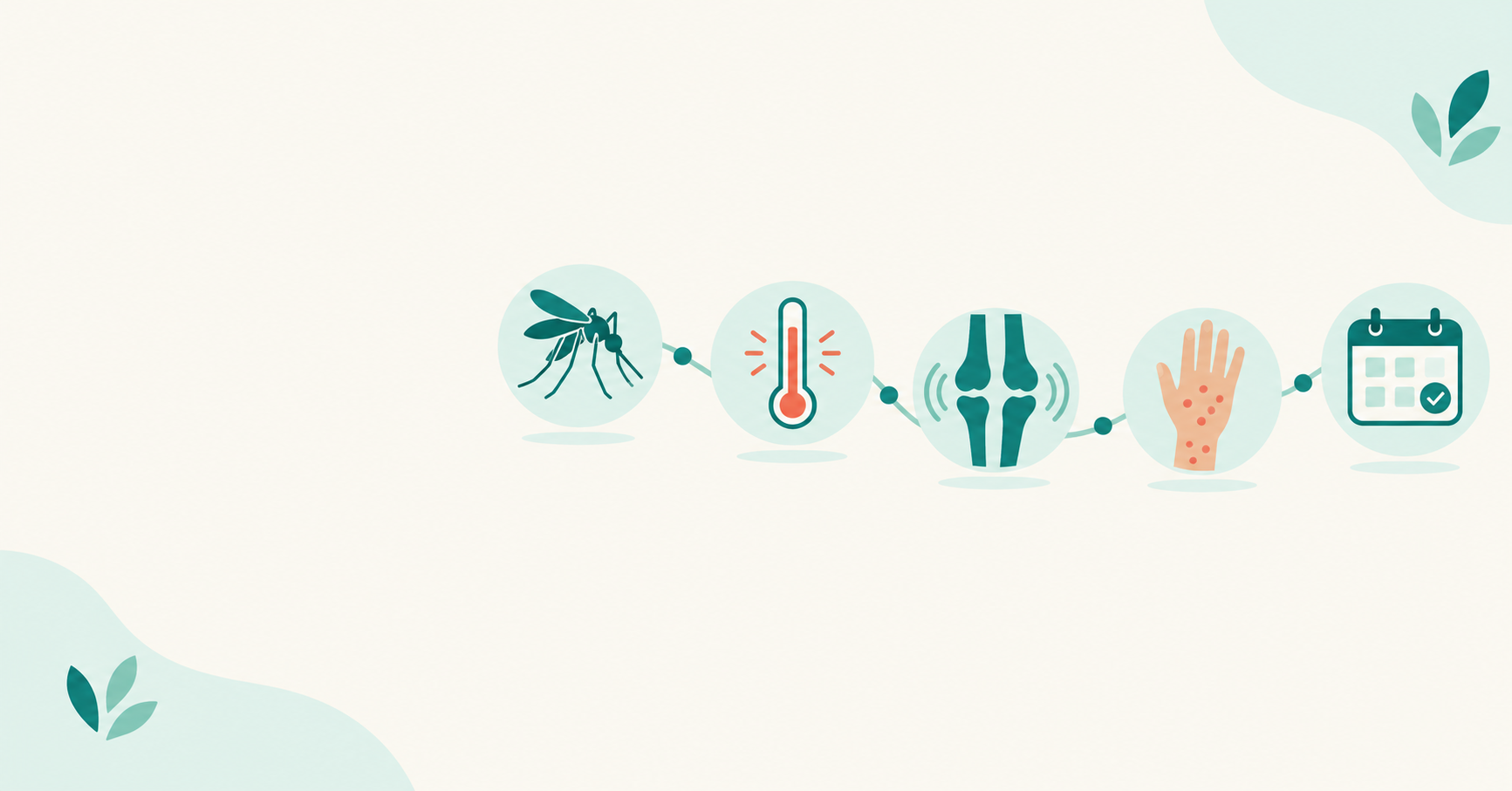
The most common chikungunya symptoms are sudden fever and joint pain. Others include headache, muscle pain, joint swelling and rash. They usually begin 3 to 7 days after an infected mosquito bite (CDC).
Early symptoms and timeline
Cleveland Clinic notes that symptoms can appear as early as 2 days or as late as 12 days after a bite. A typical course looks like this:
- Day 1 of illness: fever starts suddenly, often with chills, headache and tiredness. Mayo Clinic lists fatigue, nausea and red eyes among the symptoms.
- Soon after: joint pain begins. The CDC Yellow Book says it often affects several joints, typically on both sides of the body, and can be severe.
- A few days in: a rash may appear. Timing varies from person to person.
Not everyone feels very ill. The Yellow Book says roughly 15–35% of infected people have no symptoms. The World Health Organization (WHO) adds that mild cases can go unnoticed or be mistaken for dengue.
What does a chikungunya rash look like?
The typical chikungunya rash is “maculopapular.” That means flat red patches mixed with small raised bumps. It often appears on the trunk, hands and feet, and usually fades within days.
Doctors have described it in several case series:
- An Indian case series found the rash faded in 3 to 4 days with no lasting marks. In that series it started with the fever in most patients and a few days later in others.
- A dermatology case series reported that the rash could itch and, in some patients, left darker skin patches after it healed.
- In babies, a paediatric study found blistering skin lesions were common.
One clinical review says the rash often shows on the trunk, hands and feet early in the illness, while other reports describe it appearing a few days after the fever starts. A rash alone can’t confirm chikungunya. Many viral illnesses cause rashes.
Symptoms in babies, older adults and people with long-term conditions
Chikungunya can be more serious in newborns, adults aged 65 and over, and people with high blood pressure, diabetes or heart disease (CDC).
Newborns are at risk if infected around the time of birth. Mayo Clinic adds that serious disease can also occur in young children and pregnant people. Cleveland Clinic advises people who are pregnant, especially late in pregnancy, to avoid travel to outbreak areas. KidsHealth notes that nerve, heart or eye problems can occasionally follow the infection.
If a baby or small child has fever with feeding problems, unusual sleepiness or a spreading rash, seek medical help promptly. For more on children’s health, see our Kid’s Health section. For pregnancy, see our Women’s Health section.
Chikungunya vs Dengue Symptoms: How They Differ
Chikungunya usually causes more prominent joint pain and rash. Dengue is more likely to cause eye pain, vomiting, low platelets and dangerous warning signs. You can’t reliably tell them apart at home, so a blood test matters.
Both are spread by the same mosquitoes and look similar early on. In a Brazilian outbreak study, dengue more often caused fever, headache, vomiting, eye pain, and low platelet and white blood cell counts. Chikungunya more often caused rash and joint pain, and warning signs were more frequent in dengue.
| Clue | More typical of chikungunya | More typical of dengue |
|---|---|---|
| Joint pain | Prominent, often several joints | Less prominent |
| Rash | More common | Less common |
| Eye pain, vomiting | Less common | More common |
| Platelets (blood cells that help clotting) | Less often low | More often low |
| Serious warning signs | Less frequent | More frequent |
Sources: the Brazil outbreak study and a prospective clinical study of early predictors.
Why it matters: dengue can cause bleeding. That is why CDC clinician guidance says to manage suspected chikungunya as dengue until dengue is ruled out. It affects which painkiller is safer, as the treatment section explains. Our [dengue guide]([INTERNAL LINK: dengue fever symptoms and warning signs → proposed dengue fever article]) covers the differences in more depth.
How Is Chikungunya Diagnosed?
Doctors diagnose chikungunya with blood tests, plus your symptoms and travel history. Tell your clinician when and where you travelled (TravelHealthPro).
The CDC says your provider can order tests for chikungunya and similar viruses such as dengue and Zika. The WHO says samples taken in the first week should be tested by both antibody and virus-detection methods (RT-PCR). Which test works best depends on how many days you’ve been ill, so follow your clinician’s advice.
Chikungunya Treatment
There is no antiviral medicine for chikungunya. Treatment focuses on easing symptoms with rest, fluids and pain relief (CDC clinician guidance).
What doctors can and can’t do
The WHO states that there is no specific antiviral drug. Care is supportive. Doctors treat fever and pain, watch for dehydration, and rule out dengue.
How to treat chikungunya at home
Rest, drink plenty of fluids, and use paracetamol (acetaminophen) for pain and fever, following the label or your clinician’s advice.
The CDC lists rest, fluids and over-the-counter pain medicine as the main steps. Here is a practical plan:
- Rest. Lie down when you can. Tiredness is common.
- Drink often. Fever and sweating cause fluid loss. Small, frequent sips work if you feel sick.
- Use paracetamol (acetaminophen). Follow the packet dose, or ask a pharmacist or doctor. We don’t give doses here because they depend on age, weight and other medicines.
- Avoid more bites. The CDC says the virus is in your blood during the first week, so mosquitoes that bite you can become infected and pass it on. Use repellent, cover up and sleep under a net or screened window.
- Track your symptoms. Note when the fever, rash and joint pain began. Your clinician will want this. A journal can also help you track mood and energy.
[Get the free checklist: symptom tracker, safe-medicine reminders and red flags (PDF)]([LEAD MAGNET URL])
Medicines to avoid until dengue is ruled out
Avoid aspirin, ibuprofen and naproxen unless a clinician tells you they are safe. They can raise bleeding risk if the illness is actually dengue.
Mayo Clinic advises not taking aspirin, ibuprofen or naproxen until similar infections such as dengue have been ruled out. CDC clinician guidance says acetaminophen is the preferred first choice until dengue is excluded. For children, KidsHealth advises avoiding ibuprofen unless the doctor approves.
Once dengue is excluded, a doctor may use other drugs for stubborn joint pain. The same CDC page says anti-inflammatory drugs, corticosteroids (including creams) and physical therapy might help. Those are decisions for a clinician, not self-treatment.
How Long Does Chikungunya Joint Pain Last?
Fever and the acute illness usually settle in 7 to 10 days. Joint pain can linger for weeks or months in some people, and occasionally for years.
The CDC Yellow Book says acute symptoms typically resolve in 7–10 days. TravelHealthPro says symptoms usually improve within 1–2 weeks, but joint pain can be severe and may persist for months or even years.
| Stage | Typical timing | What to expect |
|---|---|---|
| Acute | First 7–10 days | Fever, rash, intense joint pain |
| Lingering (“subacute”) | From about 2–3 weeks up to 3 months (cut-offs vary by guideline) | Joint pain and stiffness may continue |
| Chronic | More than 3 months | Persistent or recurring joint pain or arthritis |
Guidelines draw these lines differently. A Sri Lankan guideline puts the acute phase at up to 2 weeks, subacute from 2 weeks to 3 months, and chronic beyond 3 months. A French guideline calls the first 3 weeks “acute”.
How many people get long-term symptoms depends on the study. One review says 25–40% develop chronic arthritis, and a 2022 review of guidelines says up to 40%. A 2024 trial says more than 40%. The differences reflect how each study defined and followed patients, so treat these as ranges, not exact odds.
Long follow-up studies show pain can last years in some people. In a long-term Réunion Island follow-up, inflammatory joint symptoms were still present in 17 of 30 patients re-evaluated after 13 years. All had first been referred to a rheumatologist, so they are not typical of everyone infected. Researchers have also tried to estimate how fast chronic joint pain resolves to help doctors decide on stronger drugs.
If pain is wearing you down, you’re not alone. Our guide to self-care practices for mental health has ideas for coping with long-lasting pain and fatigue.
Chronic Chikungunya Arthritis: Treatment Options
There is no agreed standard treatment for chronic chikungunya arthritis. Doctors may use pain relievers, steroids or disease-modifying drugs, and the evidence is still limited.
Chronic chikungunya arthritis frequently mimics rheumatoid arthritis. A rheumatologist (joint specialist) is the right person to assess it. Options that doctors discuss include:
- Anti-inflammatory pain relievers (NSAIDs), once dengue is excluded.
- Corticosteroids, including creams.
- Disease-modifying drugs (DMARDs) such as methotrexate. A 2019 review notes that the treatment strategy has been empirical, meaning based on experience rather than firm evidence.
- Physical therapy. CDC clinician guidance lists it as a possible help.
Guidelines don’t even agree on steroids. In a 2022 review of 28 guidelines, 13 (46%) advocated steroids in the chronic phase, while 5 (18%) advised against them.
The evidence on methotrexate is mixed. In a small randomised trial of 31 people, all of whom received the steroid dexamethasone, adding methotrexate showed a greater numerical trend towards improvement but wasn’t superior to dexamethasone alone. These drugs need medical supervision. Don’t start them on your own.
If standard care hasn’t helped, our guide on how to find a clinical trial explains how to look for studies safely.
When to Get Urgent Medical Help
Get urgent help for severe tummy pain, repeated vomiting, bleeding from the gums or nose, vomiting blood, or blood in your stools. If dengue is possible, warning signs can appear as the fever settles.
The NHS says serious dengue symptoms can appear 24 to 48 hours after your temperature returns to normal. The CDC lists vomiting at least 3 times in 24 hours as a warning sign. Seek help straight away if a baby is unwell.
Also contact a doctor promptly if you are 65 or older or have diabetes, high blood pressure or heart disease (CDC). Mayo Clinic adds pregnant people and young children to the groups at risk of serious disease. If you’ve travelled and have a high fever, severe joint pains or a rash, get urgent medical advice and say where you’ve been. Call NHS 111 or your GP, or local emergency services in an emergency.
Prevention and Vaccines
The best protection is avoiding mosquito bites. Vaccines exist, but availability and safety advice have changed recently, so check current guidance before travelling.
Cleveland Clinic recommends repellent, covering arms and legs, screens or nets, and removing standing water near your home. TravelHealthPro says repellents with 50% DEET are the most effective available and can be used in pregnancy, breastfeeding and for children from 2 months. For more tips, see our guide to [preventing mosquito bites]([INTERNAL LINK: preventing mosquito bites → proposed mosquito-bite-prevention article]).
Here is the vaccine picture as of October 2026:
- US: the CDC says the Vimkunya vaccine is available, and higher-risk travellers should consider vaccination.
- Ixchiq in the US: the FDA suspended its licence on 22 August 2025, and the maker withdrew its US application on 19 January 2026.
- EU: on 25 June 2026 the EMA’s CHMP recommended limiting Ixchiq to people aged 12 and over who are at high risk of chikungunya.
- UK: JCVI advice (July 2025) says Vimkunya may be offered from age 12, while Ixchiq may be offered only to healthy adults aged 18 to 59. It says vaccination may be considered for people travelling to regions with active outbreaks, and for long-term or frequent travellers to regions with recent transmission.
Ask a travel clinic or check TravelHealthPro before a trip.
Frequently Asked Questions
Is chikungunya contagious?
Not through everyday contact. It spreads through bites from infected mosquitoes, not through coughing, touching or saliva. Blood transmission is possible but rare (Cleveland Clinic). During the first week of illness, avoid further mosquito bites so you don’t infect mosquitoes that could pass the virus to others.
Can you get chikungunya twice?
Reinfection appears unlikely. Cleveland Clinic says most evidence suggests you develop immunity after a first infection. Mosquito-bite protection still matters, because dengue and other viruses spread the same way.
Can I take ibuprofen for chikungunya?
Not until dengue is ruled out, unless a clinician says it’s safe. Aspirin, ibuprofen and naproxen can raise bleeding risk if the illness is actually dengue. Paracetamol (acetaminophen) is the preferred early choice (Mayo Clinic; CDC). Follow the label and ask a pharmacist.
Is there a vaccine for chikungunya?
Yes, but rules vary by country. The CDC says Vimkunya is available in the US and may suit higher-risk travellers. Ixchiq has faced safety-related restrictions. In the UK, JCVI advice (July 2025) says Vimkunya may be offered from age 12 and Ixchiq only to healthy adults aged 18 to 59. Ask a travel clinic for current advice.
How long does chikungunya joint pain last?
Most acute symptoms settle in 7 to 10 days (CDC Yellow Book). Joint pain can last months in some people, and a smaller number have pain or arthritis for years. See a doctor if pain persists beyond a few weeks.
When should I go to hospital with suspected chikungunya?
Get urgent help for severe tummy pain, repeated vomiting, bleeding from the gums or nose, vomiting blood or blood in your stools, or signs of dehydration. If dengue is possible, warning signs can appear as the fever settles. Seek help if a baby is unwell. Older adults and people with diabetes, high blood pressure or heart disease should seek advice early (CDC).
Conclusion
Here are the key points:
- Chikungunya causes sudden fever and strong joint pain, often with a rash, about 3 to 7 days after a bite.
- There is no antiviral. Rest, fluids and paracetamol are the safe starting point.
- Avoid aspirin, ibuprofen and naproxen until dengue has been ruled out.
- Most people recover in 1 to 2 weeks, but joint pain can last months, and a specialist can help if it does.
- Vaccine rules have changed and differ by country. Check current guidance before you travel.
Want more evidence-checked health explainers like this one? [Get them by email]([NEWSLETTER URL]).
Next Step
Keep this guide handy during recovery. Our free Chikungunya Recovery and Red-Flag Checklist covers the symptom timeline, safe-medicine reminders, dengue clues, what to tell your doctor, and when to seek urgent help.
[Get the free checklist (PDF)]
Disclaimer: This article is general information and isn’t a substitute for professional medical advice, diagnosis or treatment. If you have a high fever, severe pain, bleeding, confusion or signs of dehydration, contact NHS 111 or your GP (or local emergency services).
Sources:
- ECDC: Chikungunya virus disease worldwide overview
- TravelHealthPro: Outbreak surveillance
- TravelHealthPro: Chikungunya in brief
- TravelHealthPro: Chikungunya vaccination information
- CDC: Symptoms of chikungunya
- CDC: Symptoms, diagnosis and treatment
- CDC: Treatment and prevention (clinicians)
- CDC Yellow Book: Chikungunya
- CDC: Chikungunya vaccine
- CDC: Severe dengue warning signs
- WHO AFRO: Chikungunya
- NHS: Dengue
- Mayo Clinic: What is chikungunya fever?
- Cleveland Clinic: Chikungunya
- KidsHealth: Chikungunya
- Symptom overlap in chikungunya and dengue (Brazil study)
- Distinguishing chikungunya from dengue and other febrile illnesses (PMC)
- Cutaneous manifestations in suspected chikungunya (PMC)
- Mucocutaneous manifestations of chikungunya fever (JPAD)
- Cutaneous manifestations of chikungunya in children (Indian Pediatrics)
- Clinical review: severe polyarthralgia, fever and rash (MDedge)
- Sri Lanka Epidemiology Unit: Chikungunya clinical management guideline
- French guidelines for the management of chikungunya
- Chronic chikungunya arthritis and methotrexate review (PMC, 2019)
- An evaluation of global chikungunya clinical management guidelines (EClinicalMedicine, 2022)
- Methotrexate and dexamethasone randomised trial (Curr Rheumatol Rev, 2024)
- Réunion Island 13-year follow-up study (HAL)
- Arthralgia resolution rate after chikungunya (PMC)
- Valneva: IXCHIQ update, January 2026
- EMA: Ixchiq (chikungunya vaccine, live)


+ There are no comments
Add yours