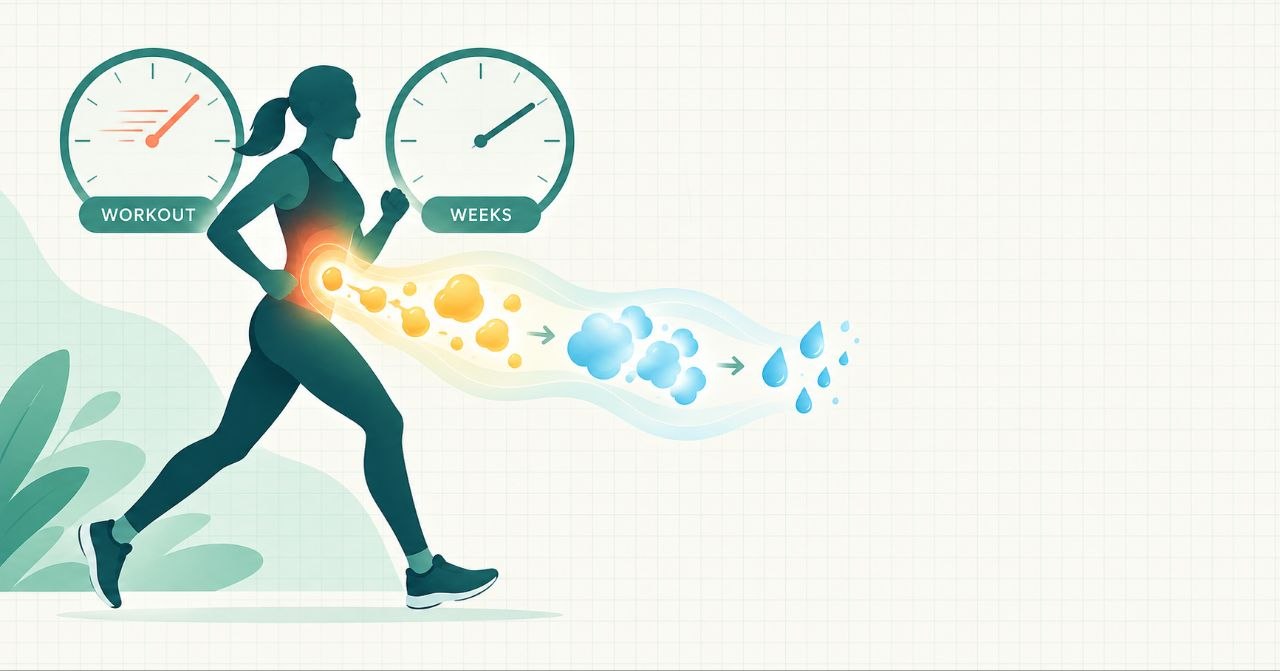
- Cardio burns fat as part of burning energy. You lose body fat when, over days and weeks, you burn more energy than you take in.
- Easier cardio uses a bigger share of fat. Harder cardio burns more calories per minute. Total energy matters most.
- Most fat you lose leaves your body as carbon dioxide you breathe out.
- Cardio works best alongside food changes and strength training. Want the workouts? See our cardio workouts for fat loss guide.
You’ve heard that cardio “burns fat.” You’ve also heard that it doesn’t. Both are partly true, and that’s why this topic is so confusing.
This guide explains how cardio burns fat, step by step. You’ll see where the fat actually goes, why the “fat-burning zone” misleads people, and how to plan a realistic week.
Does Cardio Burn Fat? The Short Answer
Yes, cardio can help you burn fat, but not in a direct, spot-by-spot way. Your muscles burn a mix of fuels during exercise, and body fat is only part of that mix. BarBend makes the same point: the calories you burn in a workout don’t all come from fat, and you lose body fat when you burn more energy than you eat across the day.
Think of it as two clocks:
- Clock 1: the workout. Which fuel do your muscles use right now?
- Clock 2: the long run. Over 24 hours and over weeks, are you using more energy than you take in?
Most of the confusion comes from mixing up the two. Clock 1 decides what you burn. Clock 2 decides whether you lose fat.
How Your Body Burns Fat During Cardio
During cardio, your muscles pull energy from a blend of carbs and fat, and the blend shifts with how hard you work. Here’s the process in three steps.
Step 1: Your Muscles Need ATP
Cardio raises your heart rate and body temperature while your body sends blood and oxygen to working muscles. That work needs adenosine triphosphate, or ATP, the energy “currency” your cells spend (Bodi). The calories you burn come mainly from two fuels: fats and carbs.
Step 2: Your Body Mixes Fuels
Your muscles can draw on several fat and carb stores:
- Carbs stored in muscle (called glycogen)
- Fat stored inside muscle (intramuscular triglycerides)
- Free fatty acids released from your body fat
One sports-nutrition source lists these fuel sources and notes that lower-intensity cardio leans more on body fat (Bulk Nutrients). Cleveland Clinic gives a handy map by heart-rate zone (Cleveland Clinic):
| Zone | % of max heart rate | Main fuel |
|---|---|---|
| 1 (easy) | 50–60% | Fat |
| 2 (moderate) | 60–70% | Fat |
| 3 (tempo) | 70–80% | Fat, carbs, and protein |
| 4 (hard) | 80–90% | Carbs and protein |
| 5 (all-out) | 90–100% | Carbs and protein |
Step 3: Oxygen In, Carbon Dioxide and Water Out
To release energy from fat, your cells combine it with oxygen. This chemical process is called oxidation. It breaks down fat into carbon dioxide (CO₂) and water. That leads to a question most people never ask: where does the fat go?
Where the Fat Actually Goes
Most of the fat you lose leaves your body through your lungs as carbon dioxide. Researchers at the University of New South Wales traced every atom in fat and found that about 84% of lost fat becomes CO₂ and about 16% becomes water, according to their BMJ paper. The lead author said the gas goes “into thin air” because we can’t see it.
The authors also reported that many health professionals they asked got this wrong.
This doesn’t mean you can breathe your way thin. The researchers stress that keeping weight off means putting less carbon back in through food than you breathe out. For scale, the lead author estimated that a 150-pound person jogging for an hour raises the carbon they exhale that day by about 20%. That’s a helpful boost, not a magic switch.
Is There a Fat-Burning Zone?
Sort of. At about 60–70% of your max heart rate, a higher share of your calories comes from fat. That doesn’t mean you burn more total fat. Cleveland Clinic puts the fat-burning heart rate at about 60–70% of max, which is zone 2 for most people and sometimes zone 1.
Percentage vs. Total Fat: A Worked Example
One exercise physiologist, quoted by HealthCentral, says roughly 65% of calories come from fat in that zone, but only about 45% at 70–80% of max heart rate. The same article notes that the harder pace can still burn more total calories, including fat calories.
Here is a simple example. The calorie numbers are hypothetical, for illustration only. Only the fat percentages come from the source above, and they vary by person [VERIFY].
| 30-minute session | Calories burned (hypothetical) | Fat share | Fat calories |
|---|---|---|---|
| Easy walk (fat-burning zone) | 150 | 65% | about 98 |
| Brisk jog (higher zone) | 250 | 45% | about 113 |
The walk has the higher fat percentage. The jog burns slightly more fat in total, and more calories overall. That’s why the zone isn’t the whole story.
How to Find Your Intensity
You don’t need a lab test, though Cleveland Clinic calls a cardiopulmonary exercise test the gold standard. Two simple options:
- Use the talk test. One source describes 50–60% of max as a comfortable pace where you can chat, and 60–70% as moderate effort where talking gets a little harder (ScienceInsights).
- Estimate your max heart rate. The easy formula is 220 minus your age (Cleveland Clinic). It’s only an estimate. A 40-year-old would get 180 beats per minute, but real max rates vary.
Want a ready-made week? [Get the free Weekly Cardio Planner (PDF)]([LEAD MAGNET URL — to be created]). It includes a sample week, a talk-test guide, and a simple intensity log.
HIIT vs. Steady-State: Which Burns More Fat?
Neither clearly wins for fat loss. High-intensity interval training (HIIT) burns more calories per minute. Steady, easier cardio uses a higher share of fat. Fat loss still depends on total calories (Fitness Society Supplements).
Research points the same way. One study of more than 400 adults with overweight or obesity found HIIT and traditional cardio reduced body fat and waist size to a similar degree. A 2023 review of 11 trials reportedly found no difference in belly-fat loss between the two styles (ScienceInsights) [VERIFY primary study].
So pick the style you’ll actually do. If you’re short on time, see our guide to HIIT workouts for busy schedules.
What “Afterburn” Really Adds
Afterburn, or EPOC (excess post-exercise oxygen consumption), is the extra energy your body uses to recover after hard exercise. It’s real but small. One trainer-written article, citing Cleveland Clinic, puts it at roughly 6–15% on top of the workout’s calories [VERIFY with primary source]. Treat it as a bonus, not a strategy.
Fasted Cardio
Fasted cardio means exercising on an empty stomach. Sources disagree: one says results depend on the person, and another calls the idea that it burns more fat a common misconception. Choose whichever timing lets you train consistently and feel well.
Why Cardio Alone Often Disappoints
Cardio adds to your daily energy use, but it’s usually a small piece of the total. BarBend notes that exercise typically burns a small fraction of what your body uses at rest, so a calorie gap is often easier to create through food. The same article cites Swift et al. (2014) for the point that exercise alone rarely causes major weight loss unless the volume is very high [VERIFY against the primary paper].
Energy Balance and Strength Training
A single cardio session generally burns more calories than a weight session of the same length. Strength training, though, builds muscle, and muscle burns more calories at rest than fat does. Healthline says combining the two often helps people lose weight, burn fat, and build muscle.
For the other half of the equation, see our guides to strength training for beginners and mindful eating for weight loss.
Belly Fat and Spot Reduction
You can’t choose where fat comes off. One review says no single type of cardio burns significantly more belly fat than another. Total effort and consistency matter more. Cycling, swimming, and rowing all work if you keep at them.
How Much Cardio Do You Need?
A common guideline for general health is at least 150 minutes of moderate cardio per week. Cymbiotika cites the American College of Sports Medicine for this (source) [VERIFY against HHS or WHO guidance]. Fat-loss goals may call for more, but build up gradually.
Here is a sample starter week. It’s a general example, not personal advice:
| Day | Activity |
|---|---|
| Mon | 30-minute brisk walk (talk test: can chat, slightly breathy) |
| Tue | Strength training |
| Wed | 20-minute interval session (HIIT) |
| Thu | Easy walk or rest |
| Fri | 30–40 minutes of cycling or easy jogging |
| Sat | Strength training or active play |
| Sun | Rest or gentle walk |
New to running? Start with our running tips for beginners.
Before You Start
Talk to a qualified healthcare professional before beginning a new routine, especially if you have a heart or joint condition, are pregnant, or take medication. Stop and seek care if you feel chest pain, severe breathlessness, or dizziness. If exercise feels tied to guilt about eating, please speak with a professional.
Frequently Asked Questions
What cardio is best for fat loss?
The best type is the one you’ll repeat. Research suggests HIIT and steady cardio can reduce body fat to a similar degree (Healthline). Mix easy sessions with occasional intervals, and pair them with strength training and sensible eating.
Why do some experts say cardio doesn’t burn fat?
They mean cardio doesn’t directly target fat. It raises your energy use, and fat loss follows only if you stay in an overall energy deficit (BarBend). During a workout, your body also burns carbs, so not every calorie comes from fat.
How long should I do cardio to burn fat?
There’s no magic minimum. BarBend says HIIT sessions are often under 20–30 minutes while steady cardio may run longer, and the best length is one you can keep doing (BarBend). Aim for consistency across the week rather than one marathon session.
What cardio burns the most belly fat?
No single type clearly wins. The research summarized by ScienceInsights points to total calorie burn and consistency as what matters most, and spot reduction is a myth. Cycling, swimming, rowing, and walking all help when done regularly.
What heart rate burns fat?
Cleveland Clinic describes a fat-burning heart rate of roughly 60–70% of your max, about zone 2 (Cleveland Clinic). That zone uses a higher share of fat, but harder exercise can still burn more total calories.
What is zone 2 cardio?
Zone 2 is moderate aerobic exercise at about 60–70% of your max heart rate. It slightly raises your heart rate, can be sustained for a long time, and carries lower injury risk (Cleveland Clinic). Brisk walking and easy cycling are common examples.
Conclusion
Here’s what to remember:
- Cardio burns a mix of carbs and fat. Easier work uses a bigger fat share; harder work burns more calories per minute.
- Fat loss happens on the long clock. You need more energy out than in, over time.
- Most lost fat leaves as CO₂ you breathe out.
- Cardio alone is rarely enough. Food choices and strength training do a lot of the work.
- Choose cardio you enjoy, build up slowly, and check with a professional first if you have health concerns.
Prefer to watch? Our YouTube channel is a good place to follow along with workouts [VERIFY that a relevant video exists, or add a short companion video].
Next Step
Turn what you’ve learned into a plan. [Get the free Weekly Cardio Planner (PDF)]([LEAD MAGNET URL — to be created]) with a sample week, a talk-test guide, and an intensity log. Want the workouts first? Start with our cardio workouts for fat loss guide.
Disclaimer: This article is for general education and isn’t medical advice. Talk to a clinician before starting a new exercise program, especially if you have a heart or joint condition, are pregnant, or take medication.
Sources
- Meerman & Brown, “When somebody loses weight, where does the fat go?” BMJ (2014), copy on ResearchGate
- UNSW Newsroom: “When we lose weight, where does the fat go?”
- NBC News/LiveScience: “Exhaled Pounds: How Fat Leaves the Body”
- ScienceDaily: BMJ study summary
- EurekAlert (BMJ Group): “Shed post-Christmas pounds just by breathing”
- WBUR: “Where Does Fat Go When You Lose Weight?”
- Cleveland Clinic: What Is Your Fat-Burning Heart Rate?
- Cleveland Clinic: Exercise and Heart Rate Zones
- Cleveland Clinic: What Is Zone 2 Cardio?
- HealthCentral: Fat Burning Heart Rate
- BarBend: Does Cardio Burn Fat?
- Swift et al. (2014), PMC, as cited by BarBend (not independently read)
- Healthline: Cardio vs. Weights for Weight Loss
- ScienceInsights: What Cardio Burns the Most Belly Fat?
- Bulk Nutrients: Do we burn actual body fat?
- Bodi: Does Cardio Burn Fat?
- Fitness Society Supplements: Does Cardio Burn Fat
- Cymbiotika: How Does Cardio Burn Fat?
- Galaxy Fit Lab: Weights vs. Cardio
- Fitbod: How Does Cardio Burn Fat?
Notes for Stage 3
- Placeholders to fill: author name, reviewer name and credentials, and the lead magnet URL. The planner doesn’t exist yet, so either build it or swap the primary CTA for the cardio workouts post.
- [VERIFY] items:
- Individual variation in the fat-share percentages.
- The 2023 HIIT vs steady-state review (find the primary paper).
- The EPOC range.
- The Swift 2014 claim (I relied on BarBend’s description).
- The 150-minute guideline (confirm against HHS or WHO).
- Whether a relevant YouTube video exists.
- Sourcing quality: several citations are secondary (brand blogs and trainer articles). Replacing them with primary studies and the HHS/WHO guidelines would strengthen the page.
- Word count and CTA placement: the body runs close to the 2,200-word target. I placed the YouTube mention in the Conclusion so the article closes on the primary CTA, as the writing rules require. The brief had listed YouTube after the primary CTA.
- The worked-example calorie figures are hypothetical and labeled that way. If you can get sourced calorie data, swap them in.


+ There are no comments
Add yours